By now this series has covered the growth cycle, the difference between shedding and thinning, the common causes, and the less obvious ones — perimenopause, iron deficiency, thyroid dysfunction, PCOS, medications, stress, nutritional gaps.
So what happens when you’ve worked through all of that and your labs still come back “normal”? This is where hair loss despite normal bloodwork gets genuinely frustrating — you’re told everything looks fine, but your part is getting wider, your ponytail feels smaller, you’re seeing more scalp in photos, or you’re still pulling handfuls of hair out of the shower drain months after you first noticed the problem.
That doesn’t automatically mean there’s some mysterious condition your doctor missed. Sometimes the explanation sits outside the standard lab panel, sometimes it’s more subtle than a single number, and sometimes the hair loss doesn’t trace back to a blood test at all. Here are seven hidden root causes of hair loss worth considering when the pieces don’t seem to fit.
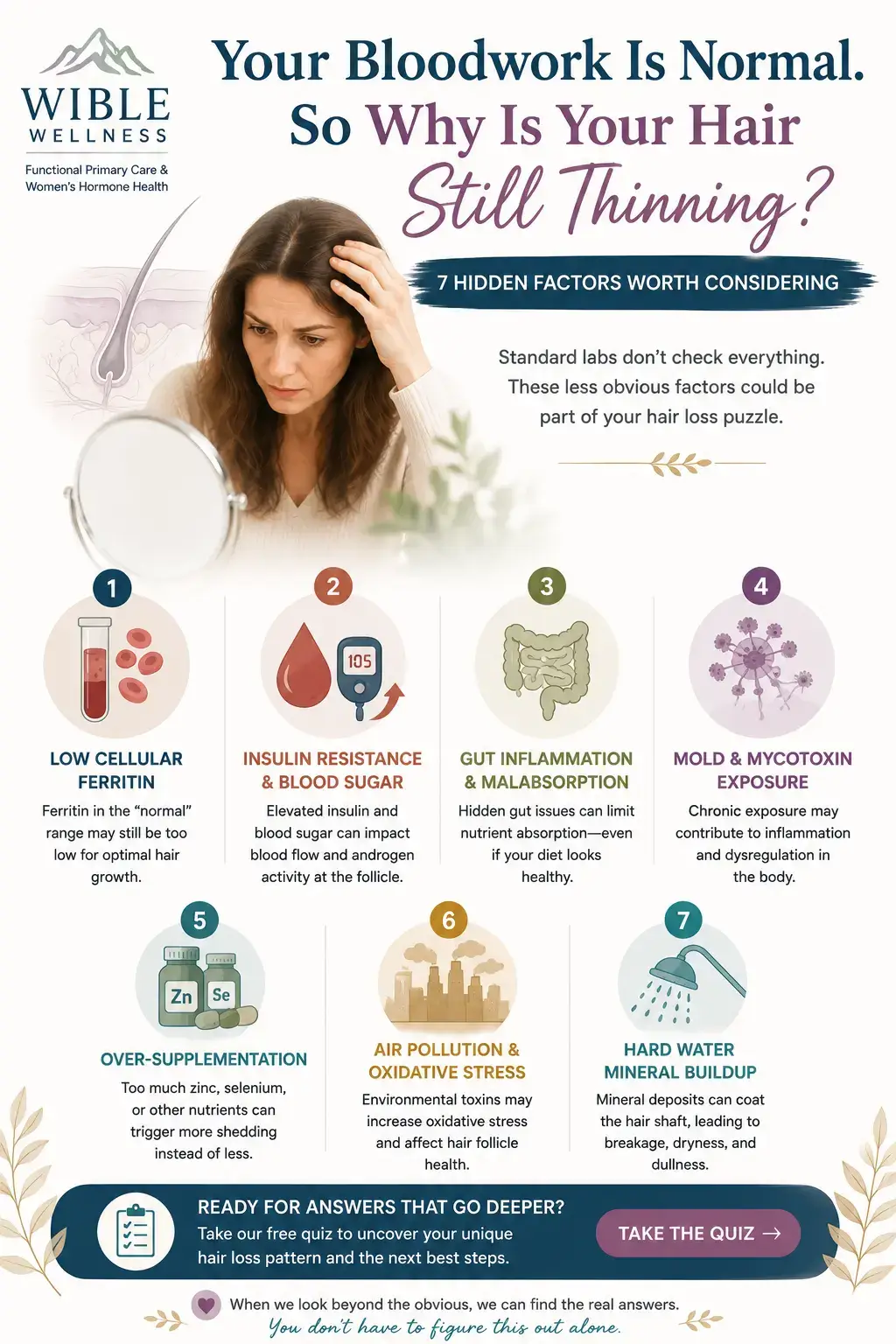
1. Your Ferritin May Be “Normal” Without Telling the Whole Story
Ferritin comes up constantly in hair-loss conversations, and for good reason — it’s a marker of your body’s stored iron, and significant iron deficiency can contribute to shedding even before you become anemic (Mirmirani & Fu, JAMA, 2021). Inadequate iron is among the nutritional factors that can contribute to hair loss.
Here’s where it gets confusing for a lot of people: you can have your CBC checked, be told you aren’t anemic, and reasonably assume iron isn’t relevant — except a CBC and a ferritin answer two different questions.
A CBC tells you about your red blood cells and whether anemia is present; ferritin tells you about iron stores specifically, and those can diverge. Non-anemic iron deficiency is a recognized entity, and correlations between low ferritin and hair shedding have been strongest at ferritin levels around ≤15–20 µg/L rather than at higher “low-normal” values (Beatrix et al., European Journal of Clinical Nutrition, 2022). It’s one of the hidden root causes of hair loss that’s easy to miss, because ferritin often gets treated as pass-or-fail instead of a spectrum.
At the same time, I don’t think it’s appropriate to tell every woman with hair loss that she needs a ferritin above some specific number. You’ll often see 70 ng/mL presented online as the magic level for hair growth, but there isn’t a universally accepted cutoff that defines “adequate iron for hair growth” — the research is genuinely mixed, and even general iron-deficiency ferritin cutoffs vary widely across guidelines, from ≤15 to <45 µg/L (Jäger et al., JAMA Network Open, 2024). Iron deficiency is common in women generally, and the relationship with female pattern hair loss and chronic telogen effluvium specifically remains debated (Olsen, New England Journal of Medicine, 2025).
I prefer to look at ferritin in context. A ferritin of 12 is a very different story than a ferritin of 65, and a ferritin of 65 means something different in a woman with heavy periods and diffuse shedding than it does in someone without those risk factors. The real question isn’t “is my ferritin normal” — it’s whether your iron status makes sense for the rest of your clinical picture.
2. Insulin Resistance May Be Part of the Hair-Loss Picture
Most people don’t associate blood sugar with hair loss, but there’s research linking insulin resistance to androgenetic or female pattern hair loss, particularly in women who have other signs of metabolic or hormonal dysfunction — a 2026 systematic review and meta-analysis found significantly higher insulin resistance (standardized mean difference 0.40) and fasting insulin levels among people with androgenetic alopecia (Li et al., BMC Public Health, 2026).
Early-onset female pattern hair loss has likewise been associated with insulin resistance and metabolic syndrome (Vujovic & Del Marmol, BioMed Research International, 2013). That’s not the same as saying insulin resistance causes hair loss in every woman — it’s one of the hidden root causes of hair loss that rarely gets checked unless the rest of the metabolic picture prompts it.
Picture someone with thinning around the crown or a widening part who also has irregular menstrual cycles, acne, increased facial or body hair, difficulty managing weight, an increased waist circumference, a history of gestational diabetes, elevated triglycerides, a strong family history of diabetes, or elevated fasting glucose or A1C — now the metabolic picture becomes genuinely interesting.
Insulin resistance and androgen signaling can overlap, especially in PCOS, where metabolic dysfunction and androgen excess often occur together and androgen-sensitive follicles may be more vulnerable to miniaturization (Li et al., BMC Public Health, 2026). And the relationship isn’t simply “high testosterone equals hair loss” either — most women with female pattern hair loss have no biochemical evidence of androgen excess, yet their follicles may be unusually sensitive to androgen signaling (Olsen, New England Journal of Medicine, 2025).
So if the pattern of hair loss suggests miniaturization and there are metabolic clues elsewhere in the history, it can make sense to look beyond a basic glucose value. That said, an association isn’t a diagnosis — I wouldn’t order an insulin panel on every woman with hair loss, only when her overall history gives a real reason to look closer.
3. Gut Health Can Matter When It Affects Nutrient Absorption
This is one of those areas where the internet has taken a reasonable idea and stretched it too far. “Leaky gut causes hair loss” isn’t a claim I’d make — there isn’t enough evidence that intestinal permeability by itself is a proven cause of hair loss. What is well established is the connection between gastrointestinal disease, nutrient absorption, and nutritional status.
Celiac disease is a good example: damage to the small intestine can cause malabsorption and deficiencies in iron, folate, B12, vitamin D, zinc, and magnesium (Ludvigsson et al., Nature Reviews Gastroenterology & Hepatology, 2025), and those nutritional deficiencies can in turn affect hair — thinning hair and brittle nails are recognized nonspecific manifestations that often improve with repletion of nutritional status (Leffler, Green, & Fasano, Nature Reviews Gastroenterology & Hepatology, 2015).
That’s a more clinically useful way to frame it than “your gut is unhealthy, so your hair is falling out” — the more accurate version is that something is interfering with nutrient absorption, and that nutritional gap is what’s contributing to the hair loss. If someone has diffuse shedding along with chronic diarrhea, bloating, unexplained iron deficiency, weight loss, abdominal symptoms, or other signs of malabsorption, the GI history deserves real attention.
Sometimes the dietary history itself is revealing, too — very restrictive diets, inadequate protein intake, prolonged elimination diets, or poorly planned gluten-free diets can create real nutritional gaps, since a gluten-free diet can itself be low in fiber and B vitamins if not well planned (Ludvigsson et al., Nature Reviews Gastroenterology & Hepatology, 2025). Which is why “I eat healthy” often isn’t quite enough information on its own — the real question is what “healthy” actually includes, and whether it’s covering what your body needs.
4. Mold Exposure Is Worth Asking About — But It Isn’t a Hair-Loss Diagnosis
Mold is probably the most controversial item on this list. Can mold exposure cause hair loss? Honestly, we don’t have strong evidence establishing it as a direct cause — though that doesn’t make mold exposure irrelevant to health generally. Mold and damp indoor environments can contribute to allergic reactions, respiratory symptoms, asthma exacerbations, and irritation; that’s simply a different claim than mold directly causing follicle miniaturization or telogen effluvium.
If a patient tells me she’s been living or working in a water-damaged building and has developed a range of new symptoms, that’s relevant history worth exploring — when the exposure began, when the symptoms began, whether the hair shedding started around the same time or months later, and what else changed during that period, since moving into a stressful environment, sleeping poorly, becoming ill, changing your diet, or developing another medical issue at the same time can all muddy the picture.
I’d also be cautious about commercially available urine mycotoxin testing — the American College of Medical Toxicology states that it is inappropriate to attribute identification of mycotoxins in urine to remote inhalation exposure, and that mycotoxin antibody testing has not been validated as a method to assess human exposure (ACMT Position Statement, 2025). So if mold is a concern, the more practical first step usually isn’t an expensive test — it’s identifying and addressing a damp or moldy environment and evaluating your actual symptoms and history. Mold can be a relevant exposure worth knowing about; it shouldn’t become the default explanation for unexplained hair loss.
5. Your “Hair Vitamins” Could Be Working Against You
This one catches people off guard. You start losing hair, so you buy a supplement built for hair growth. Then a multivitamin. Then a collagen powder. Then a separate zinc supplement, maybe a prenatal because you’ve heard it’s good for hair — and suddenly you’re taking five products with overlapping nutrients, on the assumption that more must be better. It isn’t.
Selenium is a good example: excess intake over time can actually cause hair loss and brittle or damaged nails, the exact opposite of the goal — alopecia is a hallmark feature of selenium toxicity, and the adult tolerable upper intake level is 400 mcg per day (Winther et al., Nature Reviews Endocrinology, 2020).
Zinc deserves the same attention, since high-dose supplementation can interfere with copper absorption and precipitate copper deficiency (Fosmire, American Journal of Clinical Nutrition, 1990; Sandstead, American Journal of Clinical Nutrition, 1995), which is one reason I don’t recommend taking high doses of individual minerals indefinitely without a specific reason.
Vitamin A belongs on this list too — it is fat-soluble and stored in the body, so chronic excessive intake can cause toxicity and hair loss, and vitamin-A-derived (retinoid) medications affect the hair cycle as well.
This is why I always want to see someone’s entire supplement list, not just the one product bought specifically for hair. A 2023 systematic review found that the evidence supporting nutritional supplements for hair loss, in people without an established deficiency, remains limited and inconsistent, and warned that excessive supplementation can itself cause toxic effects and interfere with lab testing (Drake et al., JAMA Dermatology, 2023). Sometimes the right move really is correcting a deficiency; sometimes it’s stopping unnecessary supplementation entirely; and sometimes the most useful thing is simply figuring out what’s actually happening before adding another pill to the pile.
Environmental exposures like air pollution and hard water round out this list of hidden root causes of hair loss, even though the evidence behind either is still developing.
6. Environmental Air Pollution May Affect the Scalp and Hair Follicle
This is a newer, more speculative area of research — I wouldn’t put it near the top of a hair-loss differential, but it’s worth knowing about. Air pollution exposes skin to particulate matter and other pollutants that can promote oxidative stress and inflammation (Kim, Cho, & Park, Life Sciences, 2016), and recent dermatology literature has found associations between long-term particulate-matter exposure and hair-related conditions — a 2026 nationwide study linked higher PM2.5 and PM10 exposure to increased incident alopecia areata, with laboratory evidence that particulate matter drives reactive oxygen species and inflammatory cytokines in hair-follicle cells (Kim et al., British Journal of Dermatology, 2026), though the clinical significance and exact mechanisms are still being worked out.
The idea is biologically plausible — follicles are highly active structures that need energy, blood flow, nutrients, and tightly regulated signaling to produce hair, and environmental oxidative stress could plausibly interfere with some of that. But there’s a real gap between “air pollution may influence hair and scalp biology” and “air pollution is causing your hair loss,” and the evidence right now only supports the first claim. For now, I’d treat environmental pollution as one potential background factor rather than a primary explanation, and if someone already has an obvious cause — female pattern hair loss, iron deficiency, thyroid disease, medication-related shedding — I wouldn’t go looking for an environmental explanation instead.
7. Hard Water May Affect Your Hair — But That Doesn’t Mean It’s Destroying Your Follicles
Hard water is another popular online explanation with a little truth buried in a lot of exaggeration. It contains higher concentrations of minerals like calcium and magnesium, and studies have shown these can deposit on the hair shaft with repeated exposure — one experimental study found increased mineral deposition and a ruffled surface appearance in hair exposed to hard water (Srinivasan & Rangachari, International Journal of Dermatology, 2016), though work on mechanical properties has been mixed, with water-hardness metals stiffening fibers in some analyses without consistent effects on tensile strength or elasticity (Evans, Marsh, & Wickett, International Journal of Cosmetic Science, 2011).
So if you’ve recently moved and your hair suddenly feels different — rougher, duller, coated, tangled, more prone to breakage — it’s reasonable to consider your water quality. But notice what’s actually being described there: the hair shaft, not the follicle. Hard water isn’t an established cause of female pattern hair loss, and I wouldn’t tell someone with progressive scalp thinning that a shower filter is going to reverse follicle miniaturization.
It may still be worth addressing if hair quality and breakage are the actual complaint. This distinction — something making your hair look thinner without your follicles actually producing less of it — comes up again and again in this series, which is exactly why identifying the type of hair problem you’re dealing with matters so much.
So What Do I Actually Mean by Hidden Root Causes of Hair Loss?
This is probably the most important part of the whole post. A hidden cause doesn’t mean there’s some exotic toxin, obscure hormone, or secret test your doctor doesn’t know about — usually it’s much simpler than that. Maybe you were told your iron was normal, but nobody looked at the full iron picture. Maybe your fasting glucose was normal, but the rest of your history suggests insulin resistance deserves a closer look.
Maybe you’re taking three different supplements that all contain zinc and selenium, or eating a very restricted diet without enough protein, or dealing with GI symptoms that suggest you’re not absorbing nutrients normally. Maybe your hair isn’t falling out from the follicle at all — it’s breaking farther down the shaft. Or maybe your bloodwork really is normal, because the cause is genetic female pattern hair loss, which doesn’t necessarily show up on a blood test in the first place (Olsen, New England Journal of Medicine, 2025).
That’s why I don’t believe in chasing every possible “root cause.” The goal isn’t to find something abnormal — it’s to figure out whether there’s something relevant. That means looking at the whole picture: what the hair loss actually looks like, whether it’s shedding, miniaturization, breakage, or something else; when it began and what happened in the months before; what medications and supplements are involved; what the menstrual and hormonal history looks like; how the diet and GI symptoms line up; what the family history shows; and what the scalp itself looks like on exam. Sometimes those pieces add up to an obvious answer. Sometimes they don’t, and that’s fine too — hair loss isn’t always a single-cause problem.
What If Your Bloodwork Really Is Normal?
If you’ve worked through all of this and you’re still losing hair, that doesn’t mean you’re out of options — it more likely means you need a more targeted workup rather than more random testing. That’s exactly where this series goes next. Ordering thirty labs isn’t the goal, and neither is ordering nothing and being told to “just watch it” — the useful middle ground is understanding which tests actually answer which questions.
For diffuse shedding, a focused panel such as TSH, ferritin, and vitamin D is generally more informative than a sprawling one (Mirmirani & Fu, JAMA, 2021). A woman with diffuse shedding and heavy periods needs a different evaluation than a woman with a widening part, acne, irregular cycles, and new facial hair; someone with GI symptoms needs a different workup than someone without them; and someone with sudden patchy loss needs an exam by a dermatologist before a long list of blood tests.
That’s really the point of walking through these hidden root causes of hair loss — not to chase every possibility, but to find the one that actually explains yours.
In the next post, we’ll get practical: what labs to actually ask for, when ferritin and iron studies make sense, what thyroid testing can and can’t tell you, when vitamin D or zinc are worth checking, when hormones belong in the workup, and why “normal” on a lab report doesn’t always answer the clinical question you’re actually trying to answer. If you’ve been told your labs are fine but your hair is telling you something different, that’s where we’ll pick up.
Disclaimer: This post is for educational purposes only and does not constitute direct medical advice. Always consult your healthcare provider regarding personal symptoms.
References
American College of Medical Toxicology. (2025). ACMT position statement: Medical toxicology considerations in the diagnosis and treatment of patients with concerns about mold-related inhalation exposures. https://www.acmt.net/wp-content/uploads/2025/08/PS_250813_ACMT-Position-Statement-Mold-Related-Inhalation-Exposures.pdf
Beatrix, J., Piales, C., Berland, P., Marchand, C., Bost, M., & Sapin, V. (2022). Non-anemic iron deficiency: Correlations between symptoms and iron status parameters. European Journal of Clinical Nutrition, 76(6), 835–840. https://pubmed.ncbi.nlm.nih.gov/34811510/
Drake, L., Reyes-Hadsall, S., Martinez, J., Heinrich, C., Huang, K., & Mostaghimi, A. (2023). Evaluation of the safety and effectiveness of nutritional supplements for treating hair loss: A systematic review. JAMA Dermatology, 159(1), 79–86. https://jamanetwork.com/journals/jamadermatology/article-abstract/2798840?utm_source=openevidence&utm_medium=referral
Evans, A. O., Marsh, J. M., & Wickett, R. R. (2011). The structural implications of water hardness metal uptake by human hair. International Journal of Cosmetic Science, 33(5), 477–482. https://pubmed.ncbi.nlm.nih.gov/21923661/
Fosmire, G. J. (1990). Zinc toxicity. American Journal of Clinical Nutrition, 51(2), 225–227. https://pubmed.ncbi.nlm.nih.gov/2407097/
Jäger, L., Rachamin, Y., Senn, O., Rosemann, T., & Markun, S. (2024). Ferritin cutoffs and diagnosis of iron deficiency in primary care. JAMA Network Open, 7(11), e2425752. https://jamanetwork.com/journals/jamanetworkopen/fullarticle/2821953?utm_source=openevidence&utm_medium=referral
Kim, K. E., Cho, D., & Park, H. J. (2016). Air pollution and skin diseases: Adverse effects of airborne particulate matter on various skin diseases. Life Sciences, 152, 126–134. https://www.sciencedirect.com/science/article/abs/pii/S0024320516301886?via%3Dihub
Kim, M., Nam, J., Lee, J., et al. (2026). Long-term particulate matter exposure and risk of alopecia areata: A nationwide epidemiological study with preliminary in vitro evidence. British Journal of Dermatology. Advance online publication. https://pubmed.ncbi.nlm.nih.gov/42311104/
Leffler, D. A., Green, P. H. R., & Fasano, A. (2015). Extraintestinal manifestations of coeliac disease. Nature Reviews Gastroenterology & Hepatology, 12(10), 561–571. https://www.nature.com/articles/nrgastro.2015.131
Li, H., Li, W., Zhang, J., et al. (2026). Risk factors for androgenetic alopecia: A systematic review and meta-analysis. BMC Public Health, 26, 1–15. https://link.springer.com/article/10.1186/s12889-026-26258-y
Ludvigsson, J. F., Yao, J., Lebwohl, B., et al. (2025). Coeliac disease: Complications and comorbidities. Nature Reviews Gastroenterology & Hepatology, 22(4), 252–264. https://www.nature.com/articles/s41575-024-01032-w
Mirmirani, P., & Fu, J. (2021). Diagnosis and treatment of nonscarring hair loss in primary care in 2021. JAMA, 326(10), 951–952. https://jamanetwork.com/journals/jama/article-abstract/2776865?utm_source=openevidence&utm_medium=referral
Olsen, E. A. (2025). Hair loss in women. The New England Journal of Medicine, 393(15), 1500–1512. https://www.nejm.org/doi/full/10.1056/NEJMcp2412146?utm_source=openevidence
Sandstead, H. H. (1995). Requirements and toxicity of essential trace elements, illustrated by zinc and copper. American Journal of Clinical Nutrition, 61(3 Suppl), 621S–624S. https://pubmed.ncbi.nlm.nih.gov/7879727/
Srinivasan, G., & Chakravarthy Rangachari, S. (2016). Scanning electron microscopy of hair treated in hard water. International Journal of Dermatology, 55(6), e344–e348. https://pubmed.ncbi.nlm.nih.gov/26711619/
Vujovic, A., & Del Marmol, V. (2013). The female pattern hair loss: Review of etiopathogenesis and diagnosis. BioMed Research International, 2013, 767628. https://onlinelibrary.wiley.com/doi/10.1155/2014/767628
Winther, K. H., Rayman, M. P., Bonnema, S. J., & Hegedüs, L. (2020). Selenium in thyroid disorders — Essential knowledge for clinicians. Nature Reviews Endocrinology, 16(3), 165–176. https://www.nature.com/articles/s41574-019-0311-6