There’s a point when hair loss stops being something you can ignore — you’re taking pictures of your part to compare month to month, pulling your hair into a ponytail and noticing it feels thinner, or watching handfuls collect in the shower and wondering how much is too much. This post is about hair loss treatment for women specifically: what actually works, what doesn’t, and why the right approach depends entirely on the diagnosis rather than the product.
By this point in the series, we’ve covered why hair loss happens, the different patterns it can take, overlooked contributors, and the bloodwork that helps identify what’s going on. Now comes the part most women actually want to know: what can I do about it?
The answer depends on the diagnosis. There isn’t one shampoo, supplement, medication, or “hair growth routine” that works for every woman, and sometimes the best treatment isn’t a hair treatment at all — it’s correcting the underlying problem that pushed the follicle into a shedding or thinning pattern in the first place. Here’s where I’d start.
Lifestyle Changes That Support Hair Growth
Lifestyle changes matter, but they work best with realistic expectations. Eating more protein isn’t going to reverse genetic female pattern hair loss on its own — but consistently under-eating, dealing with significant nutritional deficiencies, or putting your body through repeated cycles of stress and inadequate recovery can absolutely work against healthy hair growth.
Start with enough food and enough protein. Hair isn’t an essential organ, so when the body is under significant nutritional stress, hair growth can take a back seat. This can happen with restrictive diets, rapid weight loss, eating too few calories, or inadequate protein intake — nutritional inadequacy, including insufficient protein, iron, or overall calories, is a recognized contributor to noticeable hair loss (Drake et al., JAMA Dermatology, 2023). A balanced diet should provide adequate protein along with iron, zinc, vitamin D, B vitamins, and other nutrients your body needs, though that doesn’t mean a cabinet full of hair growth vitamins — taking more isn’t necessarily better (Drake et al., JAMA Dermatology, 2023).
Be careful with hair supplements. Biotin is probably the most famous ingredient in hair supplements, but true biotin deficiency is uncommon, and there isn’t good evidence that high-dose biotin improves hair growth in people who aren’t actually deficient (Drake et al., JAMA Dermatology, 2023; Kim et al., Diabetes/Metabolism Research and Reviews, 2019).
There’s another reason I pay attention to biotin specifically: it can interfere with certain lab tests, including some thyroid and hormone panels, and the FDA has specifically warned about biotin interference with laboratory testing (Li et al., JAMA, 2017; Lee and Pearce, JAMA, 2023). Biotin isn’t the only concern, either — excessive selenium, vitamin A, and iron can all potentially cause problems, including worsening hair loss in some circumstances (Drake et al., JAMA Dermatology, 2023). If a deficiency is found, replacing it makes sense; taking high doses of everything “just in case” doesn’t.
Give your body a chance to recover. Sleep and chronic stress deserve attention, especially when shedding began after a particularly stressful period. Stress doesn’t mean your hair loss is “all in your head” — physical and psychological stress can push more hairs into the shedding phase, and illness, surgery, major weight changes, and childbirth can do the same (Mirmirani and Fu, JAMA, 2021). You don’t need a perfect morning routine to have healthy hair; consistent sleep, adequate nutrition, movement, and realistic stress management are far more useful than another complicated wellness ritual.
Take care of the scalp and the hair you already have. Your scalp is skin, and it needs to be treated accordingly — if you have significant dandruff, inflammation, psoriasis, itching, or scaling, treating the scalp condition may be part of your hair loss treatment. Your styling habits matter too: repeatedly wearing very tight ponytails, buns, braids, or extensions can eventually cause traction alopecia and, in prolonged cases, permanent hair loss, and excessive heat or chemical processing can weaken the hair shaft and increase breakage (Dakkak et al., AFP, 2024).
Gentle doesn’t have to mean never coloring your hair or never using a curling iron — it means recognizing when your hair is becoming fragile and easing up on whatever’s contributing to the damage.

Medical Hair Loss Treatment for Women
Lifestyle changes support the follicle, but depending on the diagnosis, you may also need to treat the follicle directly.
Minoxidil for women. For female pattern hair loss, minoxidil is one of the best-established treatment options — topical minoxidil can help stimulate growth and slow further loss, it’s available without a prescription in several formulations, and dermatologists commonly recommend it (Olsen, New England Journal of Medicine, 2025; van Zuuren et al., Cochrane Database of Systematic Reviews, 2016). It does require patience: you may not see meaningful improvement for several months, and it commonly takes around 6 to 12 months to determine the full effect, with continued use generally necessary to maintain the benefit (Olsen, New England Journal of Medicine, 2025; Lucky et al., Journal of the American Academy of Dermatology, 2004).
One important caveat — women who are pregnant, planning pregnancy, or breastfeeding should avoid minoxidil unless specifically advised otherwise by their clinician (US Food and Drug Administration, Minoxidil Topical Solution 2% Label; Akiska et al., JAMA Dermatology, 2025). And minoxidil isn’t the answer to every type of hair loss, which is why I don’t recommend looking at a thinning part and automatically assuming you need it.
Treat the reason behind the shedding. If your hair loss is telogen effluvium following an illness, significant weight loss, severe stress, or another identifiable trigger, treatment can look very different — sometimes the most effective intervention is simply correcting the trigger and giving the hair cycle time to normalize (Mirmirani and Fu, JAMA, 2021; Dakkak et al., American Family Physician, 2024).
That means addressing iron deficiency if it’s identified, treating the thyroid disorder if thyroid disease is contributing, adjusting a medication with the prescribing clinician if one is responsible, or focusing on nutritional repletion if malabsorption is the issue — whatever the actual driver turns out to be. This is exactly why the evaluation from the previous post matters: you can’t choose the right hair loss treatment until you have a reasonable idea of what you’re actually treating.
What about spironolactone and other medications? For some women with female pattern hair loss, prescription medications may be appropriate. Spironolactone is one medication dermatologists commonly use for this — it can help reduce further loss and increase hair thickness in some women, with a minimum dose of about 100 mg/day generally needed for efficacy (Olsen, New England Journal of Medicine, 2025; Rozner et al., Breast Cancer Research and Treatment, 2019).
Other medications, including finasteride or dutasteride, may be considered in selected patients, though neither is FDA-approved for women and both require individualized medical oversight; pregnancy considerations are particularly important, since 5α-reductase inhibitors and antiandrogens can feminize a male fetus (Olsen, New England Journal of Medicine, 2025). These aren’t medications I’d recommend based on a blog post alone — your age, medical history, other medications, blood pressure, kidney function, pregnancy potential, and the actual pattern of hair loss all factor in.
When should you see dermatology or endocrinology? There are times when primary care or functional medicine is a reasonable starting point, and times when a dermatologist should be involved — particularly with rapidly progressive hair loss, smooth or sharply defined bald patches, scalp pain, burning, or significant inflammation, loss of eyebrows or eyelashes alongside scalp hair loss, a shiny or scarred appearance of the scalp, suspected scarring alopecia, real diagnostic uncertainty, or hair loss that keeps worsening despite treatment (Mirmirani and Fu, JAMA, 2021; Dakkak et al., American Family Physician, 2024).
A dermatologist can examine the scalp closely and, when necessary, use dermoscopy or a scalp biopsy to see what’s happening at the follicle level (Olsen, New England Journal of Medicine, 2025). Endocrinology may be appropriate when there’s a significant underlying endocrine disorder that needs specialist management — the goal isn’t deciding which specialty is “best,” it’s getting the right person involved when the situation calls for it.
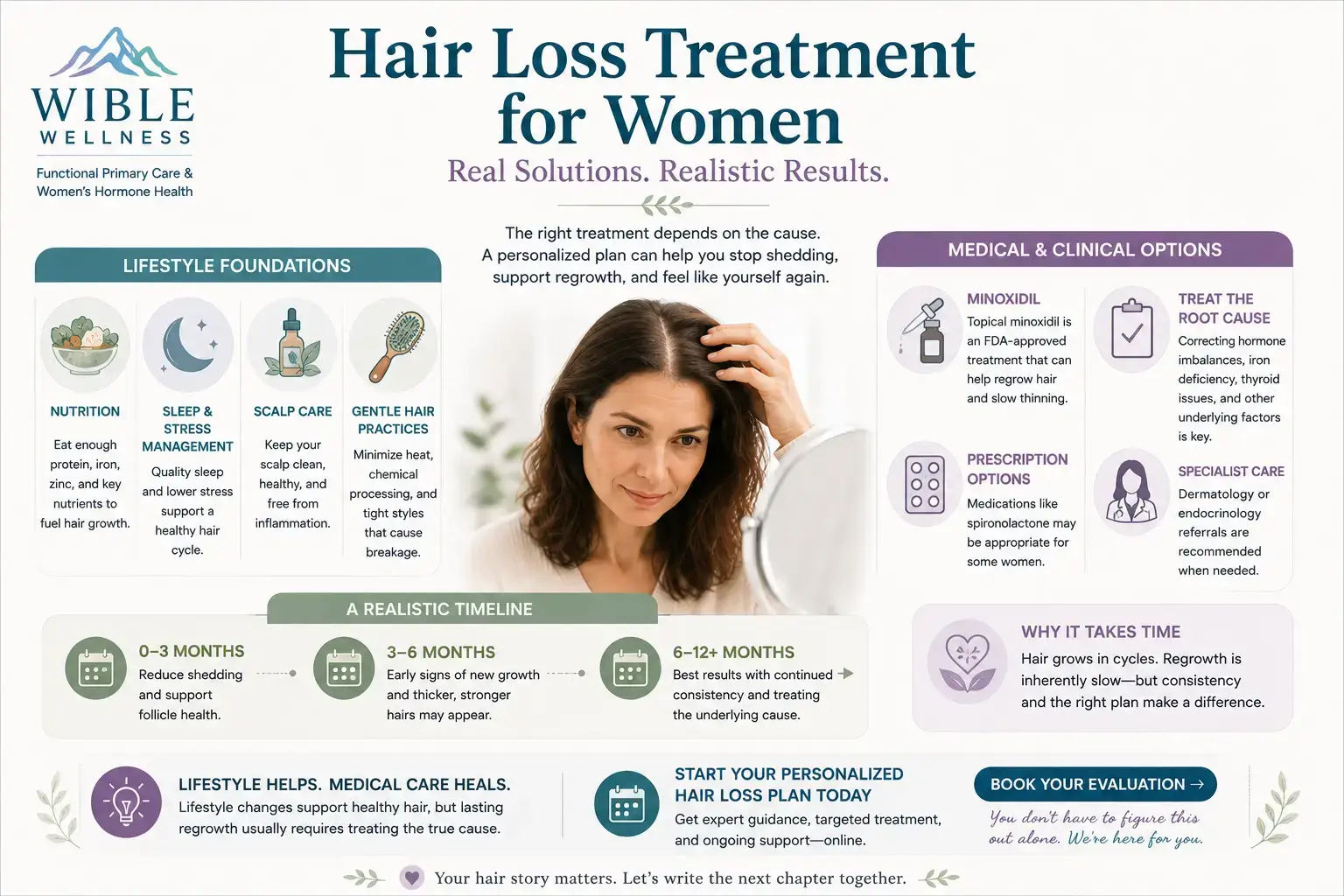
A Realistic Hair Loss Treatment Timeline
This is where I want to save you some frustration: hair grows slowly, and that’s not incidental to treatment, it’s central to it. In Post 1, we talked about the hair growth cycle and why follicles don’t all grow at the same time — that same cycle is exactly why you can’t start a treatment on Monday and expect noticeably thicker hair by Friday. Hair moves through its own biological timeline regardless of how motivated you are.
For many treatments, 3 to 6 months is a reasonable window to start looking for meaningful change, while 6 to 12 months is often a much better timeframe for judging the overall response — minoxidil, for instance, typically takes around 6 to 12 months to show its full results (Olsen, New England Journal of Medicine, 2025; Lucky et al., Journal of the American Academy of Dermatology, 2004). That can feel painfully slow when you’re checking your hair every morning, which is exactly why before-and-after photos tend to be more useful than relying on memory alone. Take them under similar lighting, with your hair positioned the same way, and compare every few months rather than every few days.
Telogen effluvium works a little differently. If the trigger has been identified and corrected, the shedding can eventually settle down and hair can start returning to its previous pattern — but shedding generally takes about 6 to 9 months to normalize, because the hairs that already entered the shedding phase still have to finish their own cycle (Mirmirani and Fu, JAMA, 2021; Dakkak et al., American Family Physician, 2024).
So even after you’ve fixed the underlying problem, your hair may not immediately look better. That doesn’t mean the treatment isn’t working; it means the follicle is running on its own schedule. And if there’s underlying female pattern hair loss happening at the same time, you may need to treat both problems rather than assuming all of the thinning came from one temporary episode (Imhof et al., Pediatrics in Review, 2020).
Why Lifestyle Alone Usually Isn’t Enough
This is probably the most important distinction in the entire series: lifestyle matters — nutrition, sleep, stress, scalp health, and avoiding unnecessary supplements and damaging hair practices all genuinely matter — but none of it is a substitute for treating an actual medical condition underneath it.
If Post 3 identified a pattern consistent with female pattern hair loss, that likely needs treatment directed specifically at the follicle (Olsen, New England Journal of Medicine, 2025). If Post 4 uncovered iron deficiency, thyroid disease, medication-related shedding, or hormonal changes, those need to be addressed directly, and if Post 5 raised less obvious possibilities like metabolic health, nutritional gaps, GI issues, or excessive supplementation, those deserve real investigation rather than getting covered up with another hair vitamin (Mirmirani and Fu, JAMA, 2021).
It’s actually pretty common for more than one of these to be happening at once — a woman can have genetic female pattern hair loss and then experience a major episode of telogen effluvium after illness or rapid weight loss, and suddenly the thinning that was developing gradually becomes far more noticeable (Imhof et al., Pediatrics in Review, 2020). In situations like that, treating only one piece of the puzzle won’t necessarily give you the result you’re looking for.
What Is the Best Hair Loss Treatment for Women Over 40?
There isn’t one treatment that’s automatically best just because a woman is over 40, but this is an age when several contributors tend to overlap. Perimenopause can bring hormonal fluctuations and changes in hair density, iron deficiency can still occur (particularly with heavy menstrual bleeding), thyroid disease becomes more common with age, medications may change, nutrition and weight can shift, and female pattern hair loss may become more noticeable over time (Olsen, New England Journal of Medicine, 2025). That’s why I don’t think “the best treatment” is a product — it’s a diagnosis. Once we understand why your hair is changing, we can decide what actually deserves attention.
Start Your Personalized Hair Loss Plan
Hair loss can be incredibly frustrating, especially when it feels like you’ve tried everything and still don’t understand what’s happening. You don’t need to chase every supplement, test every hormone, or buy every product promising thicker hair — real hair loss treatment for women starts with figuring out what’s actually going on, not with another product on the shelf. What you need is a thoughtful starting point.
At Wible Wellness, we look at the bigger picture: your hair-loss pattern, timeline, medications and supplements, nutrition, thyroid and metabolic health, hormonal changes, and anything else that might help explain what’s happening. And because hair loss sometimes turns out to be part of a bigger hormonal or systemic picture, the conversation doesn’t have to stop at your hair — perimenopause, hormone health, and general primary care concerns can all be part of the same evaluation.
Ready to understand what’s behind your hair loss? Schedule a personalized evaluation with Wible Wellness and let’s build a treatment plan based on your actual situation, not a one-size-fits-all hair supplement.
A Final Word on Hair Loss
After seven posts, we’ve gone from counting hairs in the shower to understanding what those hairs may actually be telling you. Hair loss isn’t one diagnosis — it’s a symptom, and sometimes the answer is straightforward, sometimes there are several contributing factors, and sometimes finding it takes a little more digging. But you don’t have to choose between ignoring the problem and buying every hair-growth product on the shelf.
Get the pattern right. Find the cause. Then treat it.
That’s a much better place to start.
Hair Loss Series:
Post 1: How much hair loss is normal? A complete guide.
Post 2: Why is my hair thinning? Shedding, breakage & hair loss explained.
Post 3: The 5 most common causes of hair loss in women.
Post 4: 8 overlooked causes of hair loss in women no one talks about.
Post 5: Hair loss despite normal bloodwork: 7 hidden factors to consider.
Post 6: Hair loss workup: What labs and tests you actually need.
Post 7: Hair loss treatment for women: Lifestyle changes and medical options that work.
Disclaimer: This post is for educational purposes only and does not constitute direct medical advice. Always consult your healthcare provider regarding personal symptoms.
References
Akiska, Y. M., Mirmirani, P., Roseborough, I., et al. (2025). Low-dose oral minoxidil initiation for patients with hair loss: An international modified Delphi consensus statement. JAMA Dermatology, 161(1). https://jamanetwork.com/journals/jamadermatology/article-abstract/2826573?utm_source=openevidence&utm_medium=referral
Dakkak, M., Forde, K. M., & Lanney, H. (2024). Hair loss: Diagnosis and treatment. American Family Physician, 110(3). https://www.aafp.org/afp/2024/0900/hair-loss
Drake, L., Reyes-Hadsall, S., Martinez, J., et al. (2023). Evaluation of the safety and effectiveness of nutritional supplements for treating hair loss: A systematic review. JAMA Dermatology, 159(1). https://jamanetwork.com/journals/jamadermatology/article-abstract/2798840?utm_source=openevidence&utm_medium=referral
Imhof, R. L., Davis, D. M. R., & Tollefson, M. M. (2020). Hair loss. Pediatrics in Review, 41(11). https://publications.aap.org/pediatricsinreview/article-abstract/41/11/570/35358/Hair-Loss?redirectedFrom=fulltext
Kim, M., Basharat, A., Santosh, R., et al. (2019). Reuniting overnutrition and undernutrition, macronutrients, and micronutrients. Diabetes/Metabolism Research and Reviews, 35(1). https://onlinelibrary.wiley.com/doi/10.1002/dmrr.3072
Lee, S. Y., & Pearce, E. N. (2023). Hyperthyroidism: A review. JAMA, 330(15). https://jamanetwork.com/journals/jama/article-abstract/2810692?utm_source=openevidence&utm_medium=referral
Li, D., Radulescu, A., Shrestha, R. T., et al. (2017). Association of biotin ingestion with performance of hormone and nonhormone assays in healthy adults. JAMA, 318(12). https://jamanetwork.com/journals/jama/fullarticle/2654822?utm_source=openevidence&utm_medium=referral
Lucky, A. W., Piacquadio, D. J., Ditre, C. M., et al. (2004). A randomized, placebo-controlled trial of 5% and 2% topical minoxidil solutions in the treatment of female pattern hair loss. Journal of the American Academy of Dermatology, 50(4). https://www.jaad.org/article/S0190-9622(03)04317-2/abstract
Mirmirani, P., & Fu, J. (2021). Diagnosis and treatment of nonscarring hair loss in primary care in 2021. JAMA, 325(9). https://jamanetwork.com/journals/jama/article-abstract/2776865?utm_source=openevidence&utm_medium=referral
Olsen, E. A. (2025). Hair loss in women. The New England Journal of Medicine, 393(15). https://www.nejm.org/doi/full/10.1056/NEJMcp2412146?utm_source=openevidence
Rozner, R. N., Freites-Martinez, A., Shapiro, J., et al. (2019). Safety of 5α-reductase inhibitors and spironolactone in breast cancer patients receiving endocrine therapies. Breast Cancer Research and Treatment, 174(1). https://link.springer.com/article/10.1007/s10549-018-4996-3
US Food and Drug Administration. (n.d.). Minoxidil topical solution 2% [drug label]. https://dailymed.nlm.nih.gov/dailymed/drugInfo.cfm?setid=ab30461c-f8c8-409d-9e24-d58ed8a34873
van Zuuren, E. J., Fedorowicz, Z., & Schoones, J. (2016). Interventions for female pattern hair loss. Cochrane Database of Systematic Reviews, 2016(5). https://jamanetwork.com/journals/jamadermatology/article-abstract/2597889?utm_source=openevidence&utm_medium=referral