You’re standing in the shower, looking at the hair gathered around the drain, and suddenly you’re counting.
If you’ve ever wondered how much hair loss is normal, you’re already asking the right question.
Is that normal?
Then you notice a few more strands on your brush. Maybe your ponytail doesn’t feel quite as thick as it used to. Or perhaps you’ve started noticing more hair on your pillow, your clothes, or your bathroom floor.
It’s easy to jump straight to the worst-case scenario: I’m losing my hair.
But keep in mind: losing some hair every day is completely normal. Your scalp is constantly shedding older hairs as new ones grow in (Paus & Cotsarelis, New England Journal of Medicine, 1999).
The tricky part is knowing when normal shedding has crossed into something worth investigating.
To understand that, you first need to understand what your hair is supposed to be doing in the first place.
The 4-Phase Hair Growth Cycle
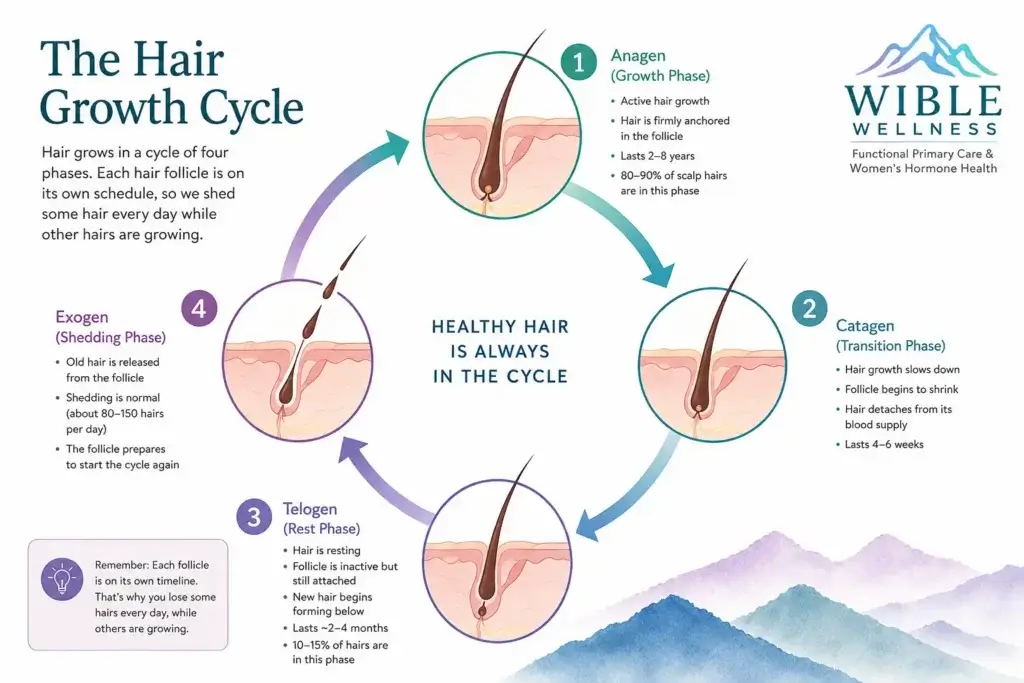
Every hair follicle goes through a repeating hair growth cycle: growth, transition, rest, and shedding (Liu et al., Nature Reviews Disease Primers, 2025).
Importantly, your follicles are not all on the same schedule. If they were, we’d all lose our hair at once every few years.
Instead, each follicle has its own biological clock (Paus & Cotsarelis, New England Journal of Medicine, 1999).
Phase | What happens | Approximate duration |
Anagen | Active hair growth | 2–8 years |
Catagen | Transition/regression | 4–6 weeks |
Telogen | Resting phase | ~2–4 months |
Exogen | Hair shedding | Variable |
Anagen — The Growth Phase
Anagen is when your follicle is actively producing hair.
The cells in the hair matrix are dividing rapidly and producing the structural components that eventually form the hair shaft. New cells are continually being produced underneath, pushing the developing hair upward (Liu et al., Nature Reviews Disease Primers, 2025).
Scalp hair can remain in anagen for approximately 2–8 years, although the duration varies from person to person (Piérard-Franchimont & Piérard, BioMed Research International, 2013).
This matters because the length of your anagen phase helps determine how long your hair can grow.
If your follicle stays in anagen for several years, you have the potential to grow very long hair. If your anagen phase is naturally shorter, your hair may reach its maximum length much sooner.
Anagen is also the phase when the follicle has some of its greatest nutritional and metabolic demands because the cells are dividing so rapidly (Liu et al., Nature Reviews Disease Primers, 2025).
Catagen — The Shutdown Phase
After years of growth, the follicle enters catagen, a short transition phase that generally lasts about 4-6 weeks.
Think of this as the follicle beginning to shut down its hair-production machinery.
Cell division decreases, and the lower portion of the follicle undergoes controlled regression. The follicle becomes smaller and prepares for its resting phase (Paus & Cotsarelis, New England Journal of Medicine, 1999).
The hair is no longer actively growing.
Telogen — The Resting Phase
Next comes telogen, the resting phase.
This generally lasts around 2–4 months, although there is natural variation (Piérard-Franchimont & Piérard, BioMed Research International, 2013).
During telogen, the old hair is no longer actively elongating. The follicle is essentially taking a break while preparing for its next growth cycle.
A new hair will eventually begin developing as the follicle transitions back toward anagen.
This is one reason the timing of hair loss can be confusing. Something that happens to your body today may affect what your hair does several months from now (Mirmirani & Fu, JAMA, 2021).
Exogen — The Shedding Phase
Finally, we have exogen, when the old hair is released from the follicle and sheds (Piérard-Franchimont & Piérard, BioMed Research International, 2013).
Some degree of shedding is completely normal. A commonly cited range is approximately 80–150 hairs per day, although there is no magic number that defines normal for every person (McDonald et al., Journal of the American Academy of Dermatology, 2017; Wasko et al., JAMA Dermatology, 2008).
How much hair you notice can also depend on how often you wash your hair.
If you wash your hair every four days, for example, you may see more hairs in the shower on wash day than someone who washes daily. That doesn’t necessarily mean you’re losing more hair overall.
The cycle then begins again:
Anagen → Catagen → Telogen → Exogen → Anagen
This cycle continues throughout your life, with each follicle operating on its own schedule (Paus & Cotsarelis, New England Journal of Medicine, 1999).
So, How Much Hair Loss Is Normal, Exactly?
So, how much hair loss is normal?
The commonly cited answer is about 80–150 hairs per day. But think of that number as a general reference point—not a daily quota you need to count. In fact, the “100 hairs a day” figure is a theoretical mathematical derivation that no clinical study has validated (Wasko et al., JAMA Dermatology, 2008).
There is considerable individual variation in normal shedding, and there isn’t a validated “normal range” specifically for women that allows us to diagnose a problem based on the number of hairs you find in your shower (Wasko et al., JAMA Dermatology, 2008).
In other words, counting every hair you lose isn’t the best way to determine whether you have a hair-loss disorder.
A better option: look for a pattern
If you’re curious about your own shedding, you can perform a simple 60-second hair count.
On a day when you haven’t just washed or heavily brushed your hair, stand over a light-colored surface and gently comb or brush your hair in the same way for 60 seconds. Count the hairs that come out (Wasko et al., JAMA Dermatology, 2008).
You can repeat this on several different days and use it as a personal baseline rather than treating one number as diagnostic.
A standardized 60-second hair count has been studied as a practical, reproducible way to monitor shedding, but the commonly cited reference study was performed in men without alopecia. So it shouldn’t be treated as a universal cutoff for women (Wasko et al., JAMA Dermatology, 2008).
For most people, the trend is more useful than a single day’s number.
And there may be a seasonal component, too.
Some studies have found that hair shedding naturally varies throughout the year, with a tendency toward increased shedding in late summer and early fall (Courtois et al., British Journal of Dermatology, 1996; Randall & Ebling, British Journal of Dermatology, 1991). Research in women has also found a seasonal pattern, with the proportion of hairs in the resting phase peaking during summer and a smaller secondary peak occurring in spring (Kunz et al., Dermatology, 2009).
So if you notice a little more hair in your brush around August, September, or October, that doesn’t automatically mean something is wrong.
Why It Often Looks Worse Than It Is
Here’s something that can make normal shedding look much more dramatic than it actually is:
You don’t exactly lose your hairs one at a time. You notice them in groups.
Infrequent washing
If you wash your hair every three or four days, the hairs that naturally shed during those days may remain tangled in your existing hair until you wash it.
Then suddenly, there they are—all in the shower at once.
That can look alarming even though those hairs may represent several days of normal shedding rather than one unusually large shedding event (Wasko et al., JAMA Dermatology, 2008).
Curly and coily hair can hold onto shed strands
Hair texture can also change how much shedding you see.
Loose hairs may remain caught within curls, coils, waves, or dense hair until you detangle or wash it.
So someone with straight hair may see individual hairs falling throughout the day, while someone with tightly curled or coiled hair may see a much larger collection of shed hairs during wash or detangling days.
The amount you see isn’t necessarily a direct measurement of how much you’re losing from the follicle.
Buns, braids, and ponytails can create a “hair dump”
If your hair is pulled back most of the day, naturally shed hairs may remain trapped in the hairstyle.
Then you take your bun or braid down and suddenly several days’ worth of shed hair comes out.
Again, timing changes what you see—but doesn’t dictate how much you’re actually shedding.
Stress can make you notice every strand
There is also a huge psychological side to this that is easy to overlook.
The moment you start worrying about hair loss, you hyper-focus on it. Suddenly, you’re spotting strands everywhere—clinging to your sweater, tangled on your pillow, and gathering in the sink.
You may start checking your part in the mirror every day or repeatedly running your hands through your hair to see what’s coming out.
This doesn’t mean the shedding isn’t real. It means our perception of shedding can become much more intense once we’re worried about it.
And that’s why looking at the overall pattern over time is often more useful than reacting to one particularly hairy shower.

People Also Ask
How much hair loss is normal per day?
Losing approximately 80–150 hairs per day is commonly considered normal. However, there is substantial individual variation, and the number of hairs you notice on a particular day isn’t enough by itself to diagnose abnormal hair loss (Wasko et al., JAMA Dermatology, 2008; McDonald et al., Journal of the American Academy of Dermatology, 2017).
Is it normal to lose hair in the shower?
Yes. Hair that has naturally reached the shedding phase may come out when you shampoo, rinse, or massage your scalp. If you wash your hair less frequently, you may see more loose hairs on wash day because they have accumulated between washes (Wasko et al., JAMA Dermatology, 2008).
Does washing your hair cause hair loss?
Washing your hair does not cause normal hair shedding. Shampooing and rinsing can simply release hairs that were already in the shedding phase. How often you wash can change how much hair you see at one time, but it doesn’t necessarily reflect how much hair you’re losing overall (Wasko et al., JAMA Dermatology, 2008).
How do I know if I’m shedding too much hair?
Look for a persistent change from your usual pattern, rather than focusing on one day’s hair count. Concerning signs can include a sustained increase in shedding, visible thinning, a widening part, a smaller ponytail, bald patches, or changes in the scalp (Mirmirani & Fu, JAMA, 2021; Dakkak et al., American Family Physician, 2024).
When should I worry about hair loss?
It’s worth having your hair loss evaluated if shedding is persistent or increasing, you notice progressive thinning or a widening part, you develop bald patches, or you have scalp symptoms such as itching, burning, pain, redness, or scaling. Sudden or dramatic hair loss also deserves evaluation (Mirmirani & Fu, JAMA, 2021; Dakkak et al., American Family Physician, 2024).
When It’s Worth a Closer Look
Normal shedding generally doesn’t cause a noticeable change in your overall hair density.
That’s why what your hair looks like over time can be more informative than how much hair you see in the drain.
Take a closer look if you notice:
- Your part is becoming wider.
- Your ponytail feels noticeably thinner.
- You can see more scalp than you used to.
- Your hair is becoming progressively finer.
- You’re experiencing persistent or dramatically increased shedding.
- You develop a bald patch or localized area of thinning.
- You’re losing eyebrows or eyelashes along with scalp hair.
- Your scalp is itchy, painful, burning, red, scaly, or otherwise changing.
- You recently experienced a major illness, surgery, significant weight loss, severe stress, or another major physiologic change and the shedding has persisted (Mirmirani & Fu, JAMA, 2021; Dakkak et al., American Family Physician, 2024).
These patterns don’t necessarily mean something serious is happening. But they tell us that it may be time to look beyond “How many hairs am I losing?”
Because hair loss isn’t one thing.
A person can have excessive shedding while the follicles themselves remain healthy (Mirmirani & Fu, JAMA, 2021). Another person may have very little noticeable shedding but be experiencing progressive follicle miniaturization (Liu et al., Nature Reviews Disease Primers, 2025). Someone else may be dealing primarily with hair-shaft breakage (Dakkak et al., American Family Physician, 2024).
And those situations require very different approaches.
The Bottom Line
If you’re finding hair in your shower drain, brush, or on your pillow, don’t panic. A certain amount of shedding is just a normal phase of your hair’s natural growth cycle (Paus & Cotsarelis, New England Journal of Medicine, 1999). Instead of stressing over a daily head count, the real question to focus on is simple: Has something actually changed?
To pinpoint what’s going on, look for these specific shifts:
- A change in your daily baseline: Are you losing noticeably more hair than your usual day-to-day normal?
- Thinner overall density: Does your hair feel less full, or do the individual strands themselves seem finer?
- Signs of breakage: Are you seeing short, snapped pieces rather than full hairs falling out from the root?
- Scalp health: Has your scalp changed in appearance, or is it dealing with new irritation, redness, or dryness?
Those clues tell us much more than a handful of hairs in the shower ever could. That’s really the answer to how much hair loss is normal: it’s not a hair count, it’s a pattern.
In the next post, we’ll take the next step and look at what “hair loss” actually means—because shedding, thinning, breakage, and follicle damage are four very different processes.
And once you know which one you’re dealing with, you can start asking the much more useful question:
Why is it happening?
Disclaimer: This post is for educational purposes only and does not constitute direct medical advice. Always consult your healthcare provider regarding personal symptoms.
References
Courtois, M., Loussouarn, G., Hourseau, S., & Grollier, J. F. (1996). Periodicity in the growth and shedding of hair. British Journal of Dermatology, 134(1), 47–54. https://pubmed.ncbi.nlm.nih.gov/8745886/
Dakkak, M., Forde, K. M., & Lanney, H. (2024). Hair loss: Diagnosis and treatment. American Family Physician, 110(3), 250–260. https://www.aafp.org/afp/2024/0900/hair-loss
Kunz, M., Seifert, B., & Trüeb, R. M. (2009). Seasonality of hair shedding in healthy women complaining of hair loss. Dermatology, 219(2), 105–110. https://pubmed.ncbi.nlm.nih.gov/19407435/
Liu, Y., Tosti, A., Wang, E. C. E., et al. (2025). Androgenetic alopecia. Nature Reviews Disease Primers, 11. https://www.nature.com/articles/s41572-025-00656-9
McDonald, K. A., Shelley, A. J., Colantonio, S., & Beecker, J. (2017). Hair pull test: Evidence-based update and revision of guidelines. Journal of the American Academy of Dermatology, 76(3), 472–477. https://www.jaad.org/article/S0190-9622(16)30892-1/fulltext
Mirmirani, P., & Fu, J. (2021). Diagnosis and treatment of nonscarring hair loss in primary care in 2021. JAMA, 325(9), 878–879. https://jamanetwork.com/journals/jama/article-abstract/2776865?utm_source=openevidence&utm_medium=referral
Paus, R., & Cotsarelis, G. (1999). The biology of hair follicles. New England Journal of Medicine, 341(7), 491–497. https://www.nejm.org/doi/full/10.1056/NEJM199908123410706?utm_source=openevidence
Piérard-Franchimont, C., & Piérard, G. E. (2013). Alterations in hair follicle dynamics in women. BioMed Research International, 2013, 957432. https://onlinelibrary.wiley.com/doi/10.1155/2013/957432
Randall, V. A., & Ebling, F. J. (1991). Seasonal changes in human hair growth. British Journal of Dermatology, 124(2), 146–151.https://pubmed.ncbi.nlm.nih.gov/2003996/
Wasko, C. A., Mackley, C. L., Sperling, L. C., Mauger, D., & Miller, J. J. (2008). Standardizing the 60-second hair count. JAMA Dermatology, 144(6), 759–762.https://jamanetwork.com/journals/jamadermatology/fullarticle/419780?utm_source=openevidence&utm_medium=referral