If you’ve made it this far in the series, you already know the causes of hair loss in women aren’t one single thing. You may be shedding more than usual, producing finer hairs as your follicles gradually miniaturize, dealing with breakage, or facing something that’s affecting the follicle itself.
So what’s actually causing it? There are a lot of possible answers — genetics, stress, pregnancy, menopause, nutrition, medications, thyroid function, hormonal changes — and it’s common for more than one to be involved at once (Mirmirani & Fu, JAMA, 2021; Olsen, New England Journal of Medicine, 2025). The frustrating part is that several of these can look nearly identical in the mirror, which is exactly why it’s worth stepping back from “what supplement should I take?” and looking at what’s actually driving the change.
5 Common Causes of Hair Loss in Women at a Glance
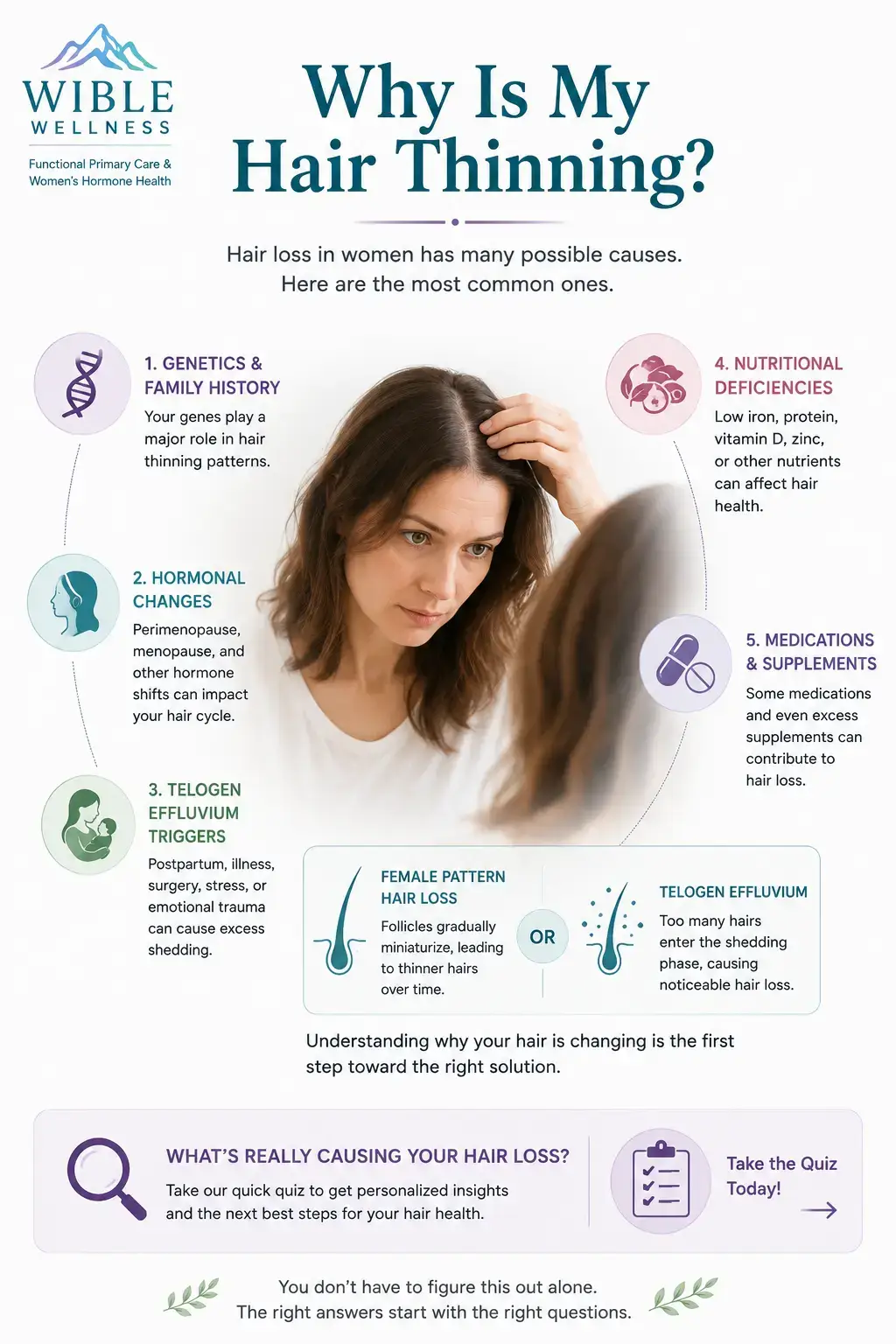
When I’m trying to figure out what’s behind someone’s hair loss, these are the five broad categories I think through first:
Genetics — Some women inherit follicles that are more susceptible to miniaturization over time, leading to female pattern hair loss (Olsen, New England Journal of Medicine, 2025).
Stress and physiologic stress — Major illness, surgery, significant emotional stress, rapid weight loss, and other physical stressors can push more follicles into the shedding phase (Mirmirani & Fu, JAMA, 2021).
Hormonal changes — Pregnancy, postpartum hormonal shifts, perimenopause, menopause, stopping certain hormonal contraceptives, and conditions associated with androgen excess can all affect the hair cycle (Piérard-Franchimont & Piérard, BioMed Research International, 2013; Gupta et al., Maturitas, 2025).
Nutritional deficiencies or inadequate intake — Hair production requires adequate energy, protein, iron, and other nutrients, and significant deficiencies can contribute to shedding (Mirmirani & Fu, JAMA, 2021).
Medications and medical conditions — A number of medications and health conditions can cause increased shedding or hair loss (Mirmirani & Fu, JAMA, 2021).
These overlap more than you’d expect. A woman might have a genetic tendency toward female pattern hair loss, then experience a major stressor that triggers telogen effluvium on top of it — suddenly noticing dramatically more shedding, while the underlying miniaturization was already happening quietly in the background (Olsen, New England Journal of Medicine, 2025). That’s exactly why untangling the causes of hair loss in women usually takes more than a single test or a single explanation.
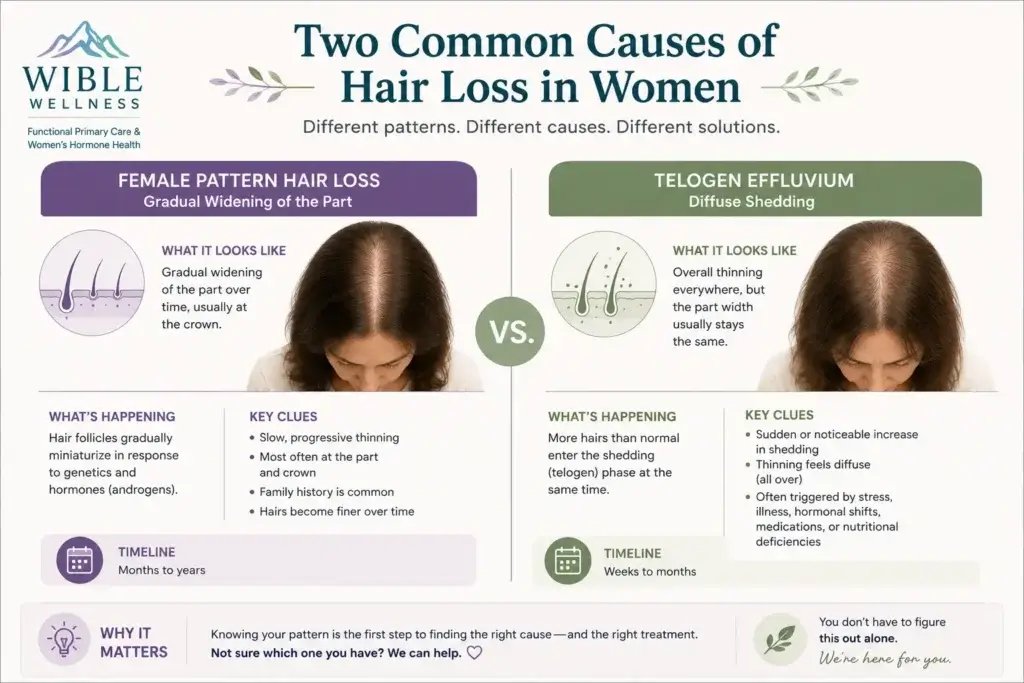
Two Big Buckets: Female Pattern Hair Loss and Telogen Effluvium
Shedding and miniaturization aren’t the same thing, and the two patterns you’ll hear about most — female pattern hair loss and telogen effluvium — can occur separately or together (Mirmirani & Fu, JAMA, 2021).
Female Pattern Hair Loss: A Miniaturization Problem
Female pattern hair loss, also called androgenetic alopecia, is the most common cause of hair loss in women. It’s generally hereditary and tends to become more noticeable with age (Olsen, New England Journal of Medicine, 2025). The underlying problem is follicle miniaturization: instead of a follicle suddenly releasing the hair and stopping, susceptible follicles gradually begin producing smaller, finer hairs over successive growth cycles, with a progressively shortened growth (anagen) phase — so the result is usually gradual rather than dramatic (Olsen, New England Journal of Medicine, 2025; Monteleone et al., Nature Reviews Endocrinology, 2018).
You might notice a widening center part, less volume at the crown, a smaller ponytail, increased scalp visibility, or hairs that seem finer than they used to be — often without much change in how much hair actually comes out in the shower. That’s the key thing to understand about this pattern: it can progress quietly while daily shedding looks completely normal, because the issue isn’t the number of hairs you’re losing, it’s the size of the hairs you’re growing (Olsen, New England Journal of Medicine, 2025). Genetics are the major factor, but they’re not the whole story — hormonal changes and age influence how noticeable it becomes, which is one reason it often shows up more clearly around midlife (Olsen, New England Journal of Medicine, 2025).
Telogen Effluvium: A Shedding Problem
Telogen effluvium works differently. Here, a larger-than-usual number of follicles shift into the resting phase and shed, producing diffuse shedding rather than one isolated bald spot — considerably more hair in the shower, on the pillow, in the brush, on clothing, or during washing and detangling (Mirmirani & Fu, JAMA, 2021).
The timing is usually the biggest clue: telogen effluvium tends to show up about two to four months after whatever triggered it, not immediately (Paus & Cotsarelis, New England Journal of Medicine, 1999; Mirmirani & Fu, JAMA, 2021). So when someone tells me “I got sick three months ago, and now my hair is coming out everywhere,” that timeline actually makes sense — and it means the useful question often isn’t “what’s happening right now” but what happened to your body two to four months ago. Telogen effluvium is a form of non-scarring hair shedding, and it doesn’t mean the follicle has been permanently damaged; the underlying follicles can keep cycling normally once things settle (Mirmirani & Fu, JAMA, 2021).
Genetics and Family History
If you’re experiencing gradual thinning, don’t overlook your family history — female pattern hair loss is hereditary, and susceptibility can come from either side of your family (Olsen, New England Journal of Medicine, 2025). It doesn’t have to look exactly like what you’re seeing, either. You might have a mother with noticeable thinning, a father with male pattern hair loss, or several relatives whose hair simply became finer with age, without anyone in your family history being what you’d call “bald.” Female pattern hair loss in women more commonly shows up as a widening part and gradual thinning across the top of the scalp rather than a receding hairline, so when you’re trying to trace your own family history, look for patterns of thinning — not just baldness (Olsen, New England Journal of Medicine, 2025).
Menopause and Age-Related Hormonal Shifts
Hair changes are common as women move through midlife, and this is one area where the biology is more complicated than “low estrogen causes hair loss.” As you move through perimenopause and menopause, ovarian hormone production changes substantially, and the relationship between estrogen, androgens, the follicle, and your individual genetic susceptibility all play into how your hair responds (Gupta et al., Maturitas, 2025; Monteleone et al., Nature Reviews Endocrinology, 2018). For some women, this is when gradual female pattern hair loss becomes more noticeable; for others, it shows up as increased shedding or a change in hair texture and density.
What looks like a purely hormonal problem is often several things happening at once — age-related follicle changes, genetic susceptibility, stress, nutritional shifts, thyroid issues, or another trigger layered together, which is why I don’t like reducing midlife hair changes to a single hormone level (Gupta et al., Maturitas, 2025). The scalp responds to the overall hormonal environment, not one isolated lab value — and there’s a lot more to unpack here, which is why we’ll spend the next post specifically on perimenopause, estrogen, progesterone, and androgen changes.
What Can Make Hair Suddenly Start Shedding?
Telogen effluvium can be triggered by more than you’d expect (Mirmirani & Fu, JAMA, 2021).
Pregnancy and postpartum hair loss. During pregnancy, hormonal changes alter the normal hair cycle, and many women experience increased hair retention. After delivery, estrogen levels fall and a larger number of hairs shift into the shedding phase — what many women describe as postpartum hair loss, suddenly finding substantially more hair in the shower or brush two to four months after giving birth (Piérard-Franchimont & Piérard, BioMed Research International, 2013; Gizlenti & Ekmekci, Journal of the European Academy of Dermatology and Venereology, 2014). It’s generally temporary; the American Academy of Dermatology notes that many women regain their normal fullness by their baby’s first birthday, though the timeline varies (Gizlenti & Ekmekci, Journal of the European Academy of Dermatology and Venereology, 2014).
Major illness or surgery. Your body doesn’t distinguish between “good” and “bad” stressors when deciding where to allocate resources, so a significant illness, high fever, surgery, hospitalization, or other major physiologic stress can disrupt the hair cycle (Mirmirani & Fu, JAMA, 2021). COVID-19, for example, has been associated with temporary telogen shedding that may not become noticeable until roughly two to three months after the infection (Aksoy et al., Dermatologic Therapy, 2021; Nalbandian et al., Nature Medicine, 2021).
Significant emotional stress or grief. Physical stress isn’t the only kind that affects the cycle — major emotional stress, grief, or prolonged psychological stress can trigger telogen effluvium too (Mirmirani & Fu, JAMA, 2021). That doesn’t mean every stressful week takes a toll on your hair; we’re talking about significant stressors, particularly alongside other changes like poor sleep, reduced food intake, weight loss, or illness.
Rapid weight loss or major dietary changes. Significant weight loss, restrictive diets, and inadequate nutritional intake are recognized triggers as well (Mirmirani & Fu, JAMA, 2021). Hair isn’t essential for survival, so when your body is short on energy or nutrients, it prioritizes more critical functions over producing a full head of hair — which is one reason shedding can sometimes be an early clue that your body has been under more physiologic stress than you realized. And again, the timing lag applies: the shedding may not show up until months after the weight loss or dietary change itself (Paus & Cotsarelis, New England Journal of Medicine, 1999).
Why Timing Matters So Much
One of the biggest mistakes in figuring out why your hair is thinning is looking only at what happened recently. Hair has a delay built into the system — if something pushes a large number of follicles out of their normal growth phase, the consequences may not show up for two to four months (Paus & Cotsarelis, New England Journal of Medicine, 1999; Mirmirani & Fu, JAMA, 2021). That means a useful hair-loss history isn’t “what changed last week,” it’s what changed over the last several months: illness, surgery, pregnancy, major stress, grief, significant weight loss, dietary changes, new medications, or other major physiologic events. Often the real answer is sitting several months behind the symptom, not in front of it.
The Bottom Line
Genetics can gradually shrink susceptible follicles. Stress or illness can push large numbers of hairs into the shedding phase. Pregnancy and postpartum hormonal changes can temporarily alter the cycle. Midlife hormonal shifts can make previously subtle thinning much more noticeable — and that’s still not the whole list. If you’ve ruled out the obvious explanations, or your bloodwork keeps coming back “normal,” there can still be other pieces worth investigating: iron status, thyroid function, nutritional intake, medications, hormonal conditions like PCOS, scalp disorders, traction, and even certain supplements, depending on the pattern you’re actually experiencing (Olsen, New England Journal of Medicine, 2025; Mirmirani & Fu, JAMA, 2021; van Zuuren et al., Cochrane Database of Systematic Reviews, 2016). The goal was never to order every test or try every supplement on the shelf — it’s to match the workup to what’s actually going on.
That’s exactly where we’re headed next: the overlooked causes of hair loss in women, the things that don’t always come up when someone’s told their labs are normal, and several of which matter most during perimenopause and midlife.
Disclaimer: This post is for educational purposes only and does not constitute direct medical advice. Always consult your healthcare provider regarding personal symptoms.
References
Aksoy, H., Yıldırım, U. M., Ergen, P., & Gürel, M. S. (2021). COVID-19 induced telogen effluvium. Dermatologic Therapy, 34(6), e15175. https://onlinelibrary.wiley.com/doi/full/10.1111/dth.15175
Gizlenti, S., & Ekmekci, T. R. (2014). The changes in the hair cycle during gestation and the post-partum period. Journal of the European Academy of Dermatology and Venereology, 28(7), 878–881. https://pmc.ncbi.nlm.nih.gov/articles/PMC8646871/
Gupta, A. K., Economopoulos, V., Mann, A., Wang, T., & Mirmirani, P. (2025). Menopause and hair loss in women: Exploring the hormonal transition. Maturitas, 195, 108216. https://www.maturitas.org/article/S0378-5122(25)00186-0/fulltext
Mirmirani, P., & Fu, J. (2021). Diagnosis and treatment of nonscarring hair loss in primary care in 2021. JAMA, 326(15), 1521–1522. https://jamanetwork.com/journals/jama/article-abstract/2776865?utm_source=openevidence&utm_medium=referral
Monteleone, P., Mascagni, G., Giannini, A., Genazzani, A. R., & Simoncini, T. (2018). Symptoms of menopause — Global prevalence, physiology and implications. Nature Reviews Endocrinology, 14(4), 199–215. https://www.nature.com/articles/nrendo.2017.180
Nalbandian, A., Sehgal, K., Gupta, A., Madhavan, M. V., McGroder, C., Stevens, J. S., Cook, J. R., Nordvig, A. S., Shalev, D., Sehrawat, T. S., Ahluwalia, N., Bikdeli, B., Dietz, D., Der-Nigoghossian, C., Liyanage-Don, N., Rosner, G. F., Bernstein, E. J., Mohan, S., Beckley, A. A., … Wan, E. Y. (2021). Post-acute COVID-19 syndrome. Nature Medicine, 27(4), 601–615. https://www.nature.com/articles/s41591-021-01283-z
Olsen, E. A. (2025). Hair loss in women. New England Journal of Medicine, 392(11), 1097–1108. https://www.nejm.org/doi/full/10.1056/NEJMcp2412146?utm_source=openevidence
Paus, R., & Cotsarelis, G. (1999). The biology of hair follicles. New England Journal of Medicine, 341(7), 491–497. https://doi.org/10.1056/NEJM199908123410706
Piérard-Franchimont, C., & Piérard, G. E. (2013). Alterations in hair follicle dynamics in women. BioMed Research International, 2013, 957432. https://onlinelibrary.wiley.com/doi/10.1155/2013/957432
van Zuuren, E. J., Fedorowicz, Z., & Schoones, J. (2016). Interventions for female pattern hair loss. Cochrane Database of Systematic Reviews, 2016(5), CD007628. https://www.cochranelibrary.com/cdsr/doi/10.1002/14651858.CD007628.pub4/full