If you’ve noticed more scalp showing through your part, your ponytail feels smaller, or your hair just doesn’t seem as full as it used to, you’re probably asking the obvious question: why is my hair thinning?
The honest answer is that “hair loss” isn’t one specific thing — it’s an umbrella term covering several different problems. You could be shedding more than usual, your follicles could be producing progressively thinner hairs, your hair could be breaking before it reaches its old length, or, less commonly, inflammation could be damaging the follicle itself (Mirmirani & Fu, 2021; Dakkak et al., 2024).
All four can look the same in the mirror. They’re not the same biologically, and the difference matters, because what’s actually happening determines what needs to be addressed.
The Hair Follicle, Briefly
A hair doesn’t simply grow out of a hole in your scalp. A hair follicle is a living mini-organ beneath the skin that produces the hair shaft (Paus & Cotsarelis, 1999).
At the very bottom of the follicle is the hair bulb, which contains the hair matrix — essentially the follicle’s manufacturing center. Its cells divide rapidly, creating the cells that eventually become the hair shaft (Paus & Cotsarelis, 1999; Liu et al., 2025). The dermal papilla sits at the base of the bulb and communicates with the surrounding follicular cells, helping regulate whether the follicle grows, transitions, rests, and starts growing again (Liu et al., 2025). Around all of this is a network of blood vessels, nerves, stem cells, hormones, and growth signals that keep the whole system running (Paus & Cotsarelis, 1999).
You don’t need to memorize any of that. What matters is this: the hair you actually see is the end product — all of the real biology is happening underneath your scalp, out of view.
Quick Recap: The Hair Growth Cycle
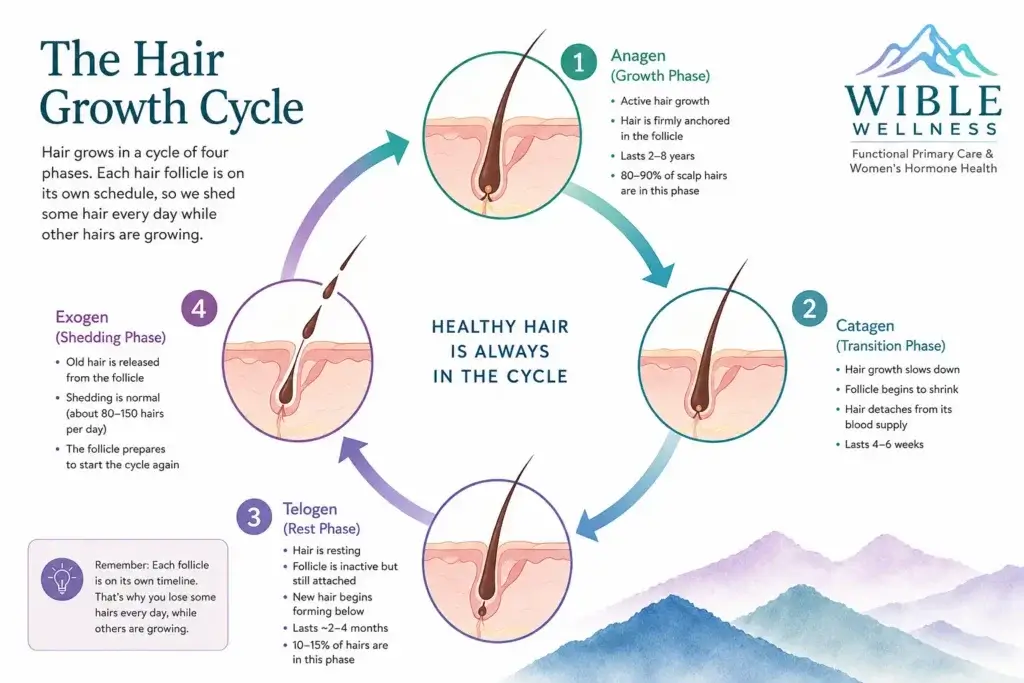
Every follicle continuously cycles through four phases: anagen (growth), catagen (transition), telogen (rest), and exogen (shedding). Each follicle runs on its own schedule, which is why we don’t lose all our hair at once (Paus & Cotsarelis, 1999). We covered exactly how this cycle works — and what normal shedding actually looks like — in Post 1: How Much Hair Loss Is Normal?. What matters here is what happens when that cycle, or the follicle itself, changes.
Density vs. Diameter — Why Both Matter
When people talk about thinning hair, they usually mean density — how many hairs are on the scalp. But density is only half the story. The other variable, one that gets far less attention, is diameter: how thick each individual hair actually is.
Picture two people who each have about 100,000 hair follicles. One person’s hairs average 70 microns across; the other’s average 40 microns. Same follicle count, very different amount of visible hair — thicker individual strands mean more volume and less scalp showing through, even with an identical number of follicles (Price, 1999; Liu et al., 2025).
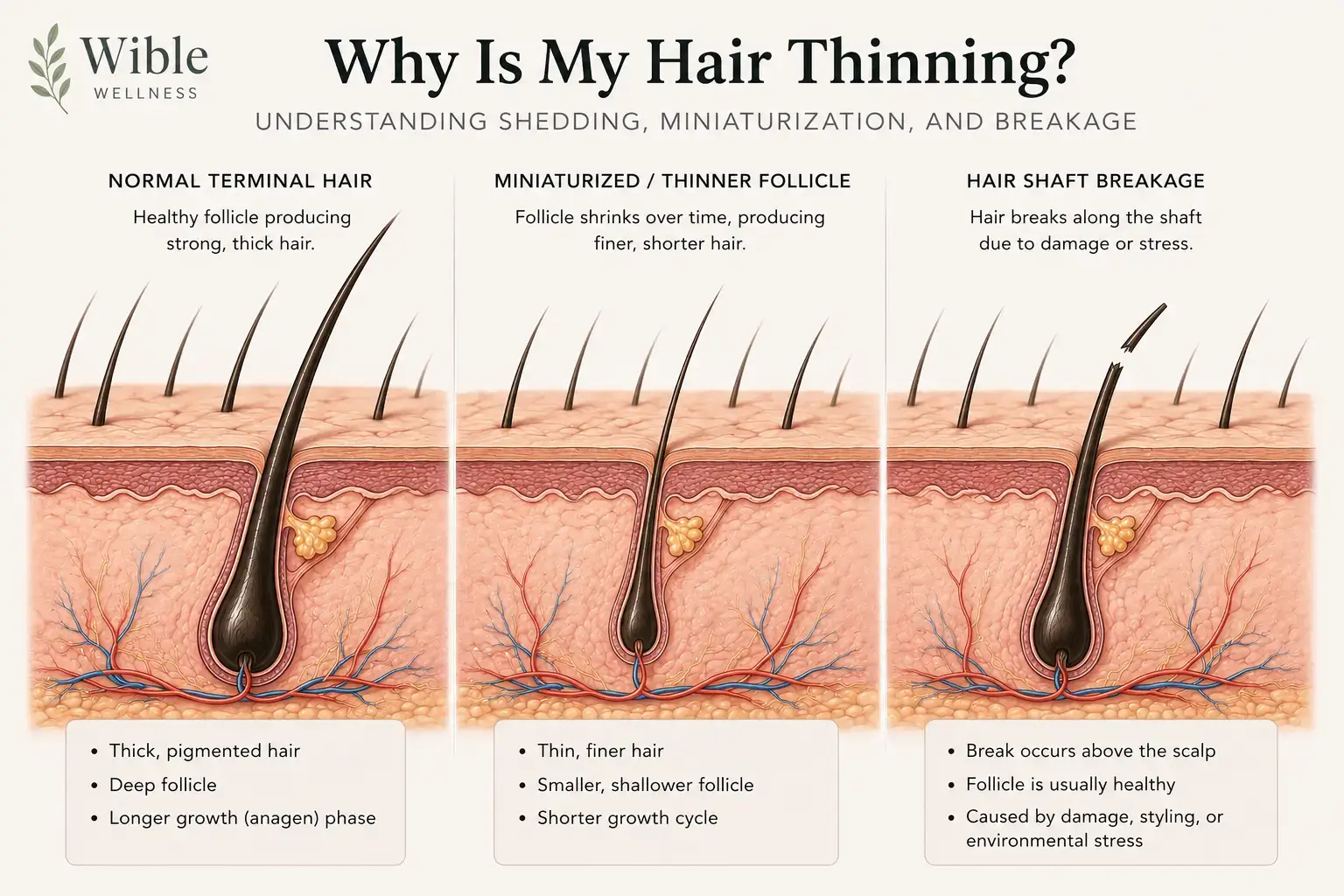
That’s the mechanism behind follicle miniaturization. With certain types of hair loss, particularly androgenetic alopecia, genetically susceptible follicles gradually shrink over successive growth cycles (Price, 1999; Liu et al., 2025) — producing hair that’s thinner, shorter, finer, and sometimes less pigmented (Price, 1999; Dakkak et al., 2024).
Over time this becomes noticeable: a widening part, more scalp showing through, a smaller ponytail, hair that just doesn’t feel as full as it used to.
This is the part that catches people off guard: you don’t have to see a dramatic increase in shedding to have progressive thinning. Often the shedding barely changes at all — it’s that each follicle is quietly producing less hair than it used to (Price, 1999).
So the more useful question isn’t just how much hair you’re losing — it’s what’s happening to the individual hairs your follicles are still producing. That distinction ends up mattering a lot once you start figuring out what’s actually going on.
The Four Things That Actually Cause Hair Loss
When someone tells me they’re losing their hair, I don’t jump to one diagnosis — I think through four different things that can be happening to the hair or the follicle itself.
- Excessive Shedding — Too Many Hairs Leave the Cycle
The first possibility is that your follicles are producing hair normally, but too many of them are entering the resting-and-shedding part of the cycle at the same time — a condition called telogen effluvium (Mirmirani & Fu, 2021). A variety of physical or physiologic stressors can trigger this shift, including:
- significant illness
- surgery
- major psychological stress
- rapid weight loss
- inadequate calorie or protein intake
- certain nutritional deficiencies
- hormonal changes
- some medications
(Mirmirani & Fu, 2021; Dakkak et al., 2024)
One of the frustrating things about telogen shedding is that it often doesn’t happen immediately after the trigger. You may experience a significant stressor in January and not notice substantial shedding until March or April — that two-to-four-month delay reflects the follicle’s own timeline (Dakkak et al., 2024). That’s why evaluating increased shedding usually means looking back over the previous several months, not just the last few weeks.
- Progressive Miniaturization — The Follicle Produces Less Hair
The second possibility is follicle miniaturization: instead of shedding dramatically more hair, the follicle gradually shrinks and produces progressively finer hairs (Price, 1999; Liu et al., 2025) — a hallmark of androgenetic hair loss.
Androgens, including DHT (dihydrotestosterone), affect genetically susceptible follicles differently depending on their location. DHT is produced locally from testosterone by the enzyme 5α-reductase, binds the androgen receptor on dermal papilla cells, and activates genes that gradually transform terminal follicles into miniaturized ones (Price, 1999; Liu et al., 2025; Dakkak et al., 2024). Repeated cycles of this can turn a thick terminal hair into an increasingly fine one, showing up as a widening part, decreased ponytail thickness, thinning at the crown, and increased scalp visibility (Dakkak et al., 2024).
This is why someone can tell you, “I’m not actually shedding that much — my hair just isn’t as thick as it used to be.” They may be describing miniaturization rather than excessive shedding.
- Shaft Breakage — The Follicle May Be Completely Fine
The third possibility isn’t hair loss from the follicle at all — it’s breakage. The hair follicle is alive, but the visible hair shaft is primarily a hardened, keratinized structure (Koch et al., 2020), and once it emerges from your scalp it’s exposed to everything you do to it: heat styling, bleaching, coloring, chemical treatments, tight hairstyles, friction, brushing, environmental exposure. Repeated exposure to any of these can weaken the shaft (Koch et al., 2020), showing up as split ends, shorter broken hairs, roughness, frizz, or reduced volume — which can look like hair loss even when the follicle itself is working fine.
That’s the real distinction: shedding is when a hair comes out from the follicle, while breakage is when it snaps somewhere along the shaft — two different problems that call for different fixes.
- Follicle Destruction — When the Follicle Is Actually Damaged
The fourth category is less common but particularly important: follicle destruction. Some inflammatory and autoimmune conditions damage the follicle itself. In certain types of scarring alopecia, inflammation destroys the follicular structure — including the stem cells in the bulge region — and replaces it with fibrous scar tissue (Harries & Paus, 2010; Hajizadeh et al., 2023; Lin et al., 2019).
This is fundamentally different from temporary shedding or miniaturization. A miniaturized follicle is still there and may keep producing hair; a permanently destroyed one can’t be “restarted” with a vitamin or a new shampoo (Harries & Paus, 2010; Lim et al., 2019). That’s one reason persistent or unusual hair loss deserves a closer look, especially with scalp symptoms like significant itching, burning, tenderness, scaling, or redness (Dakkak et al., 2024).
So, Why Is My Hair Thinning?
That question doesn’t have one universal answer, and that’s the whole point of this post: before reaching for a hair-growth supplement, it’s worth figuring out what type of change is actually happening. Are you shedding too many hairs, producing progressively thinner ones, breaking hair you already have, or dealing with inflammation that’s damaging the follicle itself? Often it’s more than one of these at once.
Your hair follicle is influenced by genetics, hormones, nutrition, metabolic health, circulation, scalp environment, inflammation, and age. Understanding that bigger picture is what lets us move past “what product should I use for hair loss?” — because the right approach depends on why the hair is changing in the first place.
In the next post, we’ll move from what type of hair loss you may be experiencing to what actually causes hair loss in women — including genetics, stress, hormonal changes, nutritional deficiencies, medications, and some of the most common patterns of female hair loss.
The Bottom Line
Hair loss isn’t one condition — shedding, thinning, breakage, and follicle destruction are four different biological processes, and it’s common for more than one to be happening at once (Mirmirani & Fu, 2021; Dakkak et al., 2024).
So if your hair looks thinner, resist the urge to fixate on how much is coming out in the shower. Look instead at the bigger picture — your overall density, whether individual strands are getting finer, whether you’re seeing breakage, whether your scalp itself has changed. That combination tells you far more than the phrase “hair loss” on its own ever could.
Next up: what’s actually behind it.
Disclaimer: This post is for educational purposes only and does not constitute direct medical advice. Always consult your healthcare provider regarding personal symptoms.
References
Dakkak, M., Forde, K. M., & Lanney, H. (2024). Hair loss: Diagnosis and treatment. American Family Physician, 110(3), 249–261. https://www.aafp.org/afp/2024/0900/hair-loss
Hajizadeh, N., Heidari, A., Sadeghi, S., & Goodarzi, A. (2023). Tumor necrosis factor inhibitors and Janus kinase inhibitors in the treatment of cicatricial alopecia: A systematic review. PLOS ONE, 18(7), e0288426. https://journals.plos.org/plosone/article?id=10.1371/journal.pone.0293433
Harries, M. J., & Paus, R. (2010). The pathogenesis of primary cicatricial alopecias. The American Journal of Pathology, 177(5), 2152–2162. https://ajp.amjpathol.org/article/S0002-9440(10)60267-2/fulltext
Koch, S. L., Tridico, S. R., Bernard, B. A., Shriver, M. D., & Jablonski, N. G. (2020). The biology of human hair: A multidisciplinary review. American Journal of Human Biology, 32(2), e23316. https://www.nejm.org/doi/full/10.1056/NEJM199908123410706?utm_source=openevidence
Lim, Y. S., Harland, D. P., & Dawson, T. L. (2019). Wanted, dead and alive: Why a multidisciplinary approach is needed to unlock hair treatment potential. Experimental Dermatology, 28(5), 517–527. https://onlinelibrary.wiley.com/doi/epdf/10.1111/exd.13898
Liu, Y., Tosti, A., Wang, E. C. E., et al. (2025). Androgenetic alopecia. Nature Reviews Disease Primers, 11, 68. https://www.nature.com/articles/s41572-025-00656-9
Mirmirani, P., & Fu, J. (2021). Diagnosis and treatment of nonscarring hair loss in primary care in 2021. JAMA, 325(9), 878–879. https://jamanetwork.com/journals/jama/article-abstract/2776865?utm_source=openevidence&utm_medium=referral
Paus, R., & Cotsarelis, G. (1999). The biology of hair follicles. The New England Journal of Medicine, 341(7), 491–497. https://www.nejm.org/doi/full/10.1056/NEJM199908123410706?utm_source=openevidence
Price, V. H. (1999). Treatment of hair loss. The New England Journal of Medicine, 341(13), 964–973. https://www.nejm.org/doi/full/10.1056/NEJM199909233411307?utm_source=openevidence